
The ‘Stick

Last night’s Monday Night Football game (likely) marked the end of the Candlestick Park era.  This was a stadium that was so difficult to get to by public transportation, and so miserably cold once you got there, that my childhood memories of Giants games there are much more about the experience of getting to, and being at, the stadium than anything that happened on the field.

Jed at StickJed Jacobsohn, former photo editor of the Berkeley High Jacket, posted this picture of himself at Candlestick after last night’s game. Jed, now an extremely successful sports photographer, has been shooting at the ‘Stick for 23 years. He’s had photos on the cover of Sports Illustrated (kind of puts our letter to the editor in perspective) and the front page of the New York Times.  He’s as good as they get.

I like to joke that I am responsible for Jed’s career (I was his “boss” as editor-in-chief of the Jacket when he was photo editor), but the truth is he was well on his way before he even started shooting for the Jacket.  He is one of those people who knew from a very early age what he wanted to do, he honed his craft in school, and then he went out and worked his way up to the elite of his profession.
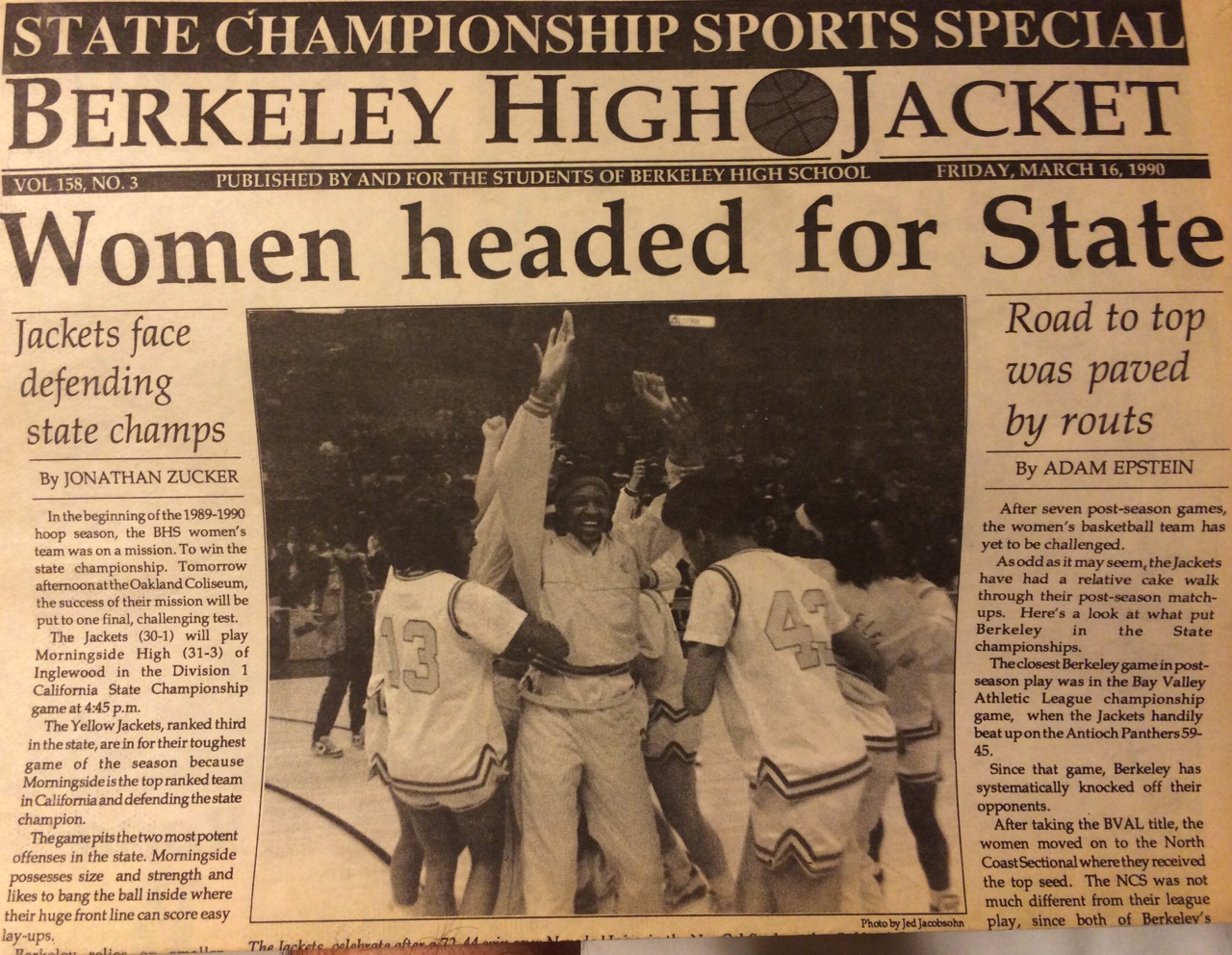
WoodsHere on the left is one of Jed’s photographs for the Jacket, in a special edition celebrating the 1989-90 BHS women’s basketball team.  That team was led by senior Jualeah Woods, who is featured in Jed’s photo and is now the assistant coach of the USC women’s basketball team.  I remember the thrill of watching the Berkeley High women play for the state championship at the Oakland Coliseum that year, even though they eventually lost to the legendary Lisa Leslie and her Morningside High team.  I was up in the stands.  As usual, Jed, with his multiple cameras, was down there right in the action, just like he was last night at the ‘Stick.

Billy Ball

24 years ago, I was a junior at Berkeley High.  On Christmas Day of that year, Billy Martin, one of Berkeley’s most famous public school graduates, passed away.Billy Martin  After reading a tribute article in Sports Illustrated about Martin’s childhood in West Berkeley, my friend Jason Brand and I dug up a cartoon in the 1946 Berkeley High yearbook featuring Martin arguing with an umpire, which of course reminded us of his legendary fights with umpires as a major league manager.

We sent the cartoon to Sports Illustrated on a whim, and were stunned when the magazine agreed to publish it as a letter to the editor.  For 16-year-old sports fans, having a letter published in Sports Illustrated was pretty much the only thing on our bucket list.

By the way, the column we read about Billy Martin’s childhood, which prompted us to send in the cartoon, was written by famed sports journalist and Berkeley High alum Ron Fimrite.  It is an illuminating glimpse into life in West Berkeley in the late 1930s and early 1940s.  For example, check out this description of Burbank Junior High (which was located on the site of the current BUSD offices at 2020 Bonar street):

West Berkeley was where . . . impoverished newcomers could afford to live, and it is where they sent their children to school. And so those schools, most specifically Burbank Junior High, became mini-war zones in themselves, beachheads where the entrenched fought fiercely to preserve their turf from the invading hordes. Billy went to Burbank Junior High, and so, a little later, did I. I can recall, on my first day there, inquiring of a classmate what the kids did for amusement at recess. This boy regarded me as if I had just debarked from a spacecraft. “We have razor fights,” he said levelly. That kind of took the kick out of recess for me. There were, in fact, two ways to survive Burbank’s tribal wars—learn to be a terrific street fighter, as Billy did, or become the companion of somebody who could fight better than all the rest.

More Berkeley integration history

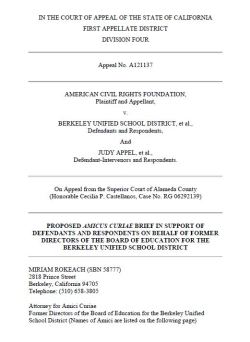
I wrote a few days ago about former Superintendent Neil Sullivan’s book about the 1968 voluntary integration of Berkeley’s public elementary schools. A bunch of people have already asked me to borrow the book, so I guess there is some interest in the topic.Rokeach brief

If you want further details about the 1968 integration plan, as well as more recent history about the integration plans that followed the 1968 plan, you should read this brief written by former school board member Miriam Rokeach.

Rokeach wrote the brief in 2008 in support of the District’s legal defense of its current school assignment plan, which was ultimately upheld by the courts.  The brief is thoroughly-researched and very readable.  I recommend it.

This is a remarkable book.

I have long known that Berkeley was one of the first cities of its size to voluntarily integrate its public schools in the late 1960s.  This occurred about 15 years after the Supreme Court ruled in Brown v. Board of Education that state-sponsored segregation was unconstitutional.  The delay reflects the prevalence, in cities like Berkeley, of segregation that was not ordered by law but was instead the result of residential housing patterns. Now is the Time In Berkeley in the 1960s, few African-American families lived in the hills, and few white families lived in the West and South Berkeley flats.  The schools at the time, particularly at the elementary level, reflected the demographics of their neighborhoods.  That is, until the Berkeley school board voted in 1968 to implement a two-way busing plan to transport African-American students from the flats to the K-3 schools in the hills, and white students from the hills to the 4-6 schools in the flats.

I knew that this had occurred and I participated in this busing plan as a student in the early 1980s; I took the bus every day to Columbus (now Rosa Parks).  But I never knew the story behind the integration of the Berkeley schools until I read, over Thanksgiving, the account of this effort in a book written by the Superintendent who shepherded the plan, Neil V. Sullivan.  Sullivan wrote the book in 1969, just after implementing the controversial elementary school busing plan, so his writing has a tangible immediacy.  He was not crowing about the success of integration upon reflection; he was urgently advocating for integration in the moment, hopeful and confident it would work but nervous enough to continue making the case throughout the book.  (The book poignantly includes a foreword by Dr. Martin Luther King, Jr., written less than a year before he was assassinated.)

Sullivan’s methods, described in gripping detail, were a model for a school district administration’s engagement with the community on sensitive and critical issues.  Berkeley residents can be proud of our city’s historic decision to integrate its schools, but we should not presume that it was easy to accomplish.  Sullivan and his allies faced literally thousands of community members at massive school board meetings (held in the Berkeley Community Theater), including many residents who were bitterly opposed to integration and, in some cases, terrified of it.  Sullivan never demonized his opponents, and he recognized that many parents, even those who supported integration, had legitimate concerns about what form the busing regime would take, how much it would cost, and what it would mean for their children.

To my mind, Sullivan was a civil rights hero.  He bravely fought for racial justice, and did so in a way that effected real, lasting change.  (And not just in Berkeley, by the way.)  In addition to the fascinating history, what struck me, though, was how far we still have to go.  The immediate challenge of Sullivan’s generation was to integrate the schools.  But, as Sullivan recognized, integration was a step forward, not a panacea.  The challenges we face today are different, but no less complicated, and no less demanding of visionary leadership.

The book is out of print and I couldn’t even find an image of the cover online, so I just took a picture of it.  It’s available at the Berkeley public library, and I also have a copy I’m happy to lend out to anyone.  Email me if you want to borrow it.

“An important skill in the 1980s”

1981 article screen

“They are . . . learning computer literacy, an important skill in the 1980s.”

Cleaning out her basement, my mom recently came across a scrapbook containing this article from April 1981, when I was in first grade at Cragmont School, and my mom was a parent volunteer.  She was, I believe, the first educator to bring computers into Berkeley public school classrooms.

The article, which notes that computer literacy is “an important skill in the 1980s,” is striking to me.  There are more computers in the District now, of course, but I am not convinced that most kids’ elementary school classroom experience is being enhanced by technology to a significantly greater extent than mine was as a Berkeley student thirty years ago.

Thanks to our local special tax (BSEP), we have a dedicated annual budget for technology in Berkeley, but it is limited.  Very little money from the District’s general fund is spent on technology; the teachers, classified support staff, and the technology itself are all stretched thin, even with BSEP funds and the generous support of the Berkeley Public Schools Fund.  There are islands of exciting innovation across the District, in some schools and in some classrooms, and the District has used one-time funds to temporarily add one more teacher on special assignment to support all schools with the use of technology and the new Common Core standards.  But as this District document makes clear, the use of technology varies widely from school to school across the city.

I would like to see us evaluate what we are doing well with respect to technology, and how we could improve.  We should study whether best practices from other districts can provide models for technology instruction that we may want to adapt and implement, and whether doing so will require a greater expenditure of resources from the District’s general fund.  With the new Local Control Funding Formula (LCFF) on the horizon, now is the time to consider whether there is more we can be doing with technology, particularly if it can be used to support teachers in their efforts to boost the achievement of English Learners and children from lower-income families.  The community input that is a key component of the LCFF process provides a perfect opportunity for parents, teachers, classified staff, and administrators to engage with each other about the potential for technology in our schools.

In addition, as I learned recently, some members of the District’s “Technology Subcommittee” are proposing that the District commission a study, perhaps to be conducted (at no cost) by grad students at U.C. Berkeley’s Goldman School of Public Policy.  In general, I am a huge proponent of taking advantage of the research capabilities of our neighbors on the U.C. campus; our new superintendent, Dr. Evans, speaks often about capitalizing on this infrequently-tapped resource. Doing so now — to assess where we are and where we could be with respect to technology (or at the very least to research best practices from similarly situated districts) — seems like an easy call to me.

What will state testing look like this year?

There has been a lot of confusion and uncertainty around the state testing regime this year, and I thought I would take a stab at explaining in simple terms where things stand as of today:

With the move to Common Core, it was only a matter of time before the old CST tests were retired.  But because the new tests, based on the Common Core standards, are not required until next school year (2014-15), there was a question about what to do this school year.  California education officials decided to do away with the old CST tests, and administer only a “field test” of the new Common Core-based English and Math tests this year.  These tests, which will be administered via computer, are being developed by a group of educators and policymakers called the Smarter Balanced Assessment Consortium (SBAC).  Under California’s plan, students in grades 3 through 8, and 11, will have to take the SBAC field tests this year.  Each student will take the field test in Math and English, but no individual scores will be reported, so the “validity and reliability” of the tests can be assessed before any consequences are attached to the results.  In other words, this is just an opportunity to “test the test.”  The tests are supposed to take 3.5 hours per student and will likely be administered in 45 minute increments over a long testing window from March through June.

The Legislature passed this law, called AB 484, and Governor Brown signed it in October.  According to the lead sponsor of the bill, State Superintendent Tom Torlakson, “It’s time for a clean break from assessments that are out of date and out of sync with the work our schools are doing to shift to the Common Core and help students meet the challenges of a changing world.”  (Note that students in the 5th, 8th, and 10th grade will still take the old CST science tests this year, and the scores will be reported.  This is because the new science standards have not yet been finalized.)

The federal government, however, has pushed back, and wants California to administer the old CST tests this year, based on the old state standards, so that we will not miss out on a year of test scores.  Education Secretary Arne Duncan has threatened to withhold billions of dollars in federal aid if California does not administer – and score – the CST tests.  Thus, there is a game of educational chicken going on.  California officials have called Secretary Duncan’s bluff, and consensus in the educational community seems to be that eventually Duncan will blink, allowing the one-year break from reported scores.

For now, the bottom line is that Berkeley students in grades 3 through 8, and 11, will have to take the field test in either English or Math this spring, but individual scores will not be reported to anyone. In my view, this temporary reprieve from high-stakes standardized testing is a welcome relief, particularly in a year marked by so much change in the K-12 curriculum.  The question it raises, though, is how much time is going to be spent preparing for these “tests of the tests”?  BUSD is legally required to administer the field tests.  But we have a unique opportunity to dispense with any test prep this year.  Let’s see what happens when every instructional minute is spent on student learning, and not one is spent on test-taking strategies.

Awful, wonderful school pictures

Nothing I have ever posted on Facebook (except that I am running for school board, actually) has garnered as much positive reaction as this school picture Casey brought home the other day:

casey

One thing I love about this picture, in addition to the suit (which was his idea, for the record) and the crazy hair and the goofy smile, is the ridiculous green background, which is a classic public school “school picture day” background.  There’s nothing artisinal about it; there’s a reason we call them school “pictures” and not school “portraits.”  Compare, for example, the preschool “portrait” of Casey’s little brother Owen on the left, and Owen’s kindergarten picture on the right:

owen3Same kid, same shirt even.  But only one of them prompted Owen’s teacher (whom we adore) to pull me aside and slip me the name of a website that publishes awkward school pictures (you can google it).

I don’t have any larger point here, but I will say this: there are a lot of ways in which I would like to see the Berkeley public schools embrace innovation to a greater extent than we do.  But I’m glad that school pictures haven’t changed.

Common Core and high-stakes tests

I posted this over on my Facebook page, but thought I would do so here as well.  One of the things I would love to do in this campaign (and on the school board) is spark more conversation than I think currently exists in Berkeley about the damaging nature of our high-stakes testing culture. I’m cautiously optimistic about the Common Core, but we need to make sure we don’t become overly obsessed with the new state tests. Charles Blow‘s op-ed (from a couple months ago) nails it: “Because we insist on prioritizing testing over teaching — punishments over preparation — we run the risk of turning Americans off one of the few educational strategies in recent memory that most people say we need.”  The demise of the CST (also called STAR) tests, and the advent of the Common Core, is an opportunity for us, as a District, to re-evaluate how much emphasis we place on the results of the annual state tests.  We can’t ignore them, but I believe we can exercise more discretion in terms of how much weight we ascribe to their results.

Blow’s op-ed has some blind spots (here’s Diane Ravitch’s take on his citation of the Broad Foundation and international test scores, if you’re interested), and his unconditional endorsement of the Common Core standards seems premature to me.  But I like how he captures the effect our high-stakes testing culture has on the ability of teachers to practice their craft: “We have drifted away from the fundamentals of what makes a great teacher: the ability to light a fire in a child, to develop in him or her a level of intellectual curiosity, the grit to persevere and the capacity to expand. Great teachers help to activate a small thing that breeds great minds: thirst.”

It’s important for parents to know that the Common Core does not mean an end to annual high-stakes tests.  More to come on this subject.

This is only a test.

Don’t worry – not the CST test.  This is just a test to see if the blogging function on this website works.  I’ve never blogged before but I think this will be a useful way for me to comment on various issues facing the Berkeley schools.  I will link to the blog posts on my Facebook page, so if you want to make sure you don’t miss one, go ahead and “like” my Facebook page, which you can find here: http://www.facebook.com/tyalperforschoolboard.

I want to experiment, during the campaign, with different methods of communication – not only to reach more voters, but also to further my thinking about the ways in which BUSD can improve its communication with parents, guardians, and the larger community.  There’s been some real improvement over the past few years in that area, but I still think that, as a District, we don’t reach enough of our intended audience with important school-related information.  Some of the District’s methods of communication are outdated and therefore less effective than they could be.  If we want parents to be engaged in their children’s education, we need to clearly and effectively communicate with them — all of them (not just those who, like me, are on email all day long).

So this blog post is a test just to see if I successfully figured out the blogging function on this website.  And the blog generally is a test of one method of communication that I plan to use during the campaign, and hopefully as a board member as well.